


A parent’s guide to the fastest-growing alternative in education
If you have ever watched your child trudge home from school looking completely drained, or sat through a parent-teacher meeting where your genuine concerns got squeezed into two minutes and a printed report card, you have probably wondered whether there is another way. You are not alone. More parents than ever are asking that question, and the answers they are finding look very different from the schools we grew up with.
Homeschooling is usually the first alternative that comes to mind. And in the same breath, people mention online schooling as if the two were interchangeable. They are not. They get bundled together because both happen outside a school building, and that is roughly where the similarity ends.
What home schooling gets right
Let me start by saying I have enormous respect for homeschooling families. The parents who take it on properly are doing something remarkable. They know exactly where their child is with fractions. They can slow down for a week when a concept refuses to land, or race ahead when it clicks on day one. No child gets left at the back of a class of forty, quietly lost.
That personalisation is real, and it is powerful. When a child learns at their own pace, with someone who knows them deeply, the anxiety drains out of learning. Curiosity comes back. Any parent who has watched that transformation will tell you it is worth a great deal.
Where it starts to strain
Here is what those same parents will also tell you, usually after the second cup of coffee. Homeschooling asks one person, or two, to be the teacher, the curriculum designer, the examiner, the timetable maker, and still the parent at the end of the day. That is five jobs. Most of us struggle with two.
The strain shows up in predictable places. Mathematics is fine until it isn’t. Science needs labs. And the biggest question of all sits quietly in the background for years before it suddenly becomes urgent: qualifications. Universities and employers do not accept “my mother taught me, and she was brilliant.” They ask for recognised certificates from recognised boards. Arranging IGCSE or A Level examinations as a private candidate is possible, but it is paperwork-heavy, and the child prepares for high-stakes exams without teachers who have coached hundreds of students through them before.
There is also the relationship cost that nobody warns you about. When the person correcting your algebra is the same person telling you to tidy your room, the lines blur. Some families manage it beautifully. Many find it exhausting.
Enter online schooling
This is where online schooling changes the picture. Think of it as keeping everything homeschooling promised, then adding back the parts of a school that actually work.
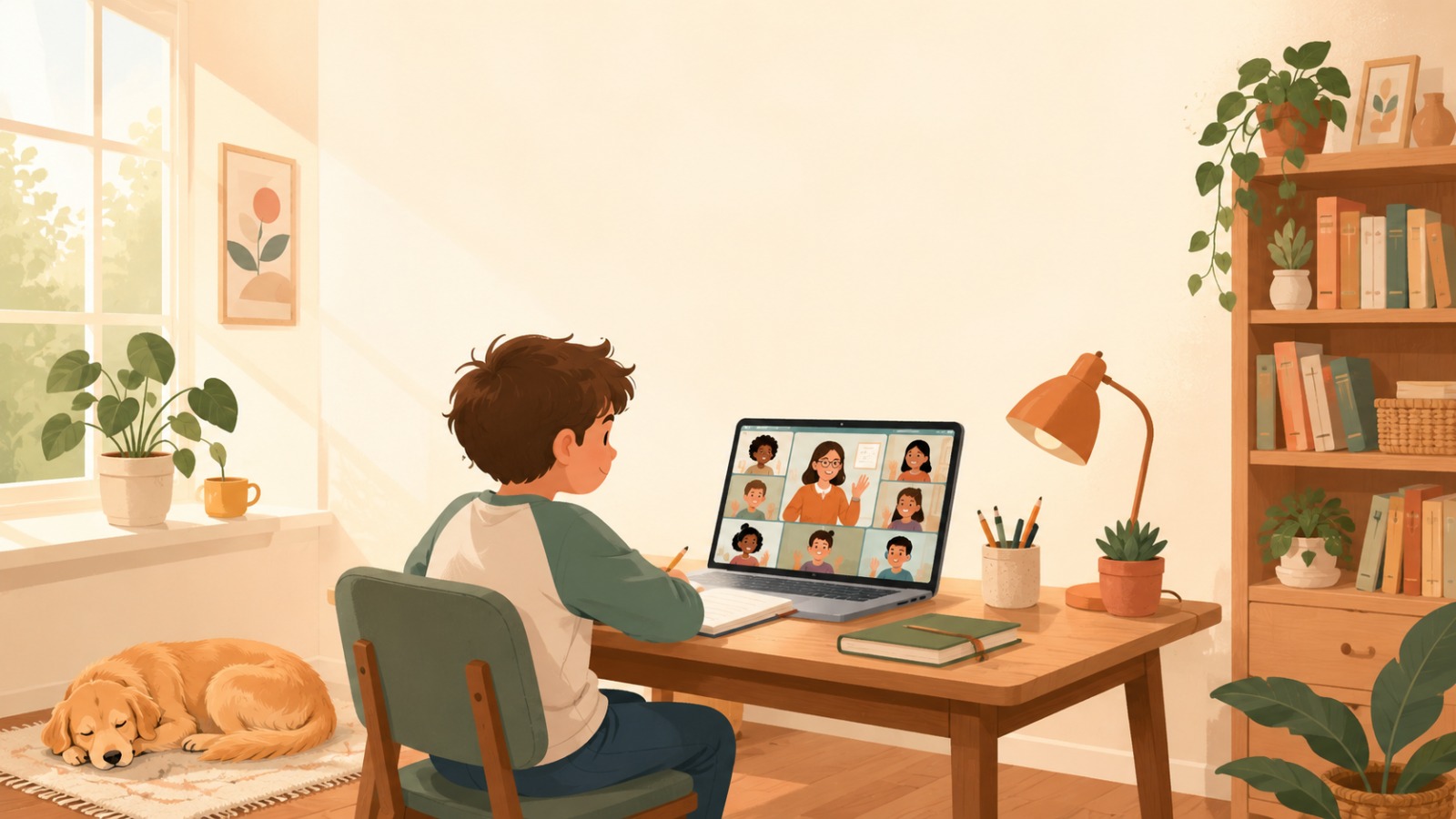
Your child still learns from home. The pace is still humane, the class sizes small, and the environment safe. But now there is a proper timetable. Live lessons, taught in real time by qualified subject teachers who answer questions on the spot. A structured, accredited curriculum leading to internationally recognised qualifications such as Cambridge or Pearson Edexcel IGCSEs and A Levels. Formal assessments, progress reports, exam registration handled by people who do it every year, and guidance when university applications come around.
And you? You go back to being the parent. You stay involved, you see the progress, but you are no longer expected to explain quadratic equations at nine in the evening. In my experience, that single shift does more for family harmony than anything else.
But what about friends?
The socialisation question comes up every single time, and it deserves an honest answer rather than a defensive one.
Yes, an online school day involves fewer corridor conversations than a physical one. It is also true that good online schools are not solitary places. Children attend live classes with the same classmates all year, work on group projects, join clubs, and build friendships that are entirely real to them, even if they span three countries. Meanwhile, home remains the base for football practice, music lessons, community groups, and the neighbourhood friends who were always going to matter more than school acquaintances anyway.
Worth remembering, too, that a busy playground is not automatically a healthy one. For a child who has faced bullying or crippling classroom anxiety, online schooling is often where their confidence quietly rebuilds.
Who is this actually for?
Over the years, I have seen online schooling work brilliantly for families who relocate often, for young athletes and performers whose training does not fit an 8-to-3 timetable, for expat families who want continuity in a British curriculum wherever work takes them, for children managing health conditions, and for bright children who were simply bored stiff in a conventional classroom.
It is not for everyone. It asks for a reasonable internet connection, a quiet corner, and a child who can, with support, settle into a routine at home. But for the families it fits – it fits like nothing else.
Choosing well
If you are considering it, ask any school you speak to four questions. Which body accredits you? Are your teachers qualified in the subjects they teach? Are lessons live or recorded? And how do you arrange examinations in my country? The good schools answer all four without blinking.
Homeschooling proved that children can thrive outside a traditional classroom. Online schooling takes that proof and builds a proper structure around it, with teachers, qualifications, and a community attached. Same freedom. Far less weight on your shoulders.
That, in the end, is the difference.