


Data-Driven Insights: Helping Parents Understand Their Child Better Gamification: Making Learning Feel Natural and Fun
Al Tutors and Virtual Assistants: Support Beyond the Classroom Customized Lesson Plans: Matching Your Child’s Goals and Interests How Technology Encourages Independent and Confident Learners? The Parent’s Role in the Personalised Learning Journey Final Thoughts.
If you’re a parent today, you’ve likely felt the tug-of-war between wanting the best for your child and watching them struggle to keep up with a pace that isn’t designed for them. Every child has a unique rhythm, preferred learning style, and comfort level, yet traditional classrooms often teach as if every student moves through knowledge at the same speed.
Recent research shows that students in personalized learning programs score 30% higher on standardized tests compared to their peers in traditional classrooms. Not only that, but motivation soars as well: 75% of students in personalized learning environments feel engaged, compared to just 30% in conventional settings. Schools leveraging technology for personalized pathways also report a 12% increase in attendance rates and a 15% reduction in dropout rates, powerful signs that when students learn at their own pace and style, they not only succeed academically but also enjoy learning more.
Personalised learning paths change that. And thanks to modern technology, these paths are becoming more effective, more intuitive, and more aligned with how children naturally learn.
Let’s explore how tech is creating better, smarter learning journeys that let your child grow at their pace, with clarity, ease, and confidence.
Why Personalised Learning Matters for Your Child?
Children learn differently, some grasp new concepts instantly, while others need more time or a different explanation. Personalised learning paths make space for these differences by adjusting the journey to the child instead of the other way around.
Today’s tech-driven platforms quietly analyse:
- What does your child understand already?
- Where do they struggle?
- How much support do they need?
- The pace at which they’re most comfortable?
This ensures the learning experience stays relevant, manageable, and genuinely helpful, with
Adaptive Learning Algorithms: The “Brain” Behind Personalised Paths
At the core of these personalised experiences are adaptive algorithms, intelligent systems designed to observe how your child interacts with each task.
For example, if your child flies through vocabulary exercises, the system levels up automatically, offering advanced tasks that keep them stimulated. If they hesitate or make repeated mistakes, the tool slows down, offers guided practice, or reshapes the lesson.
This dynamic adjustment mirrors what a thoughtful tutor would do: watch for cues, respond appropriately, and maintain an experience that suits your child’s pace and progress.
Data-Driven Insights: Helping Parents Understand their Child Better
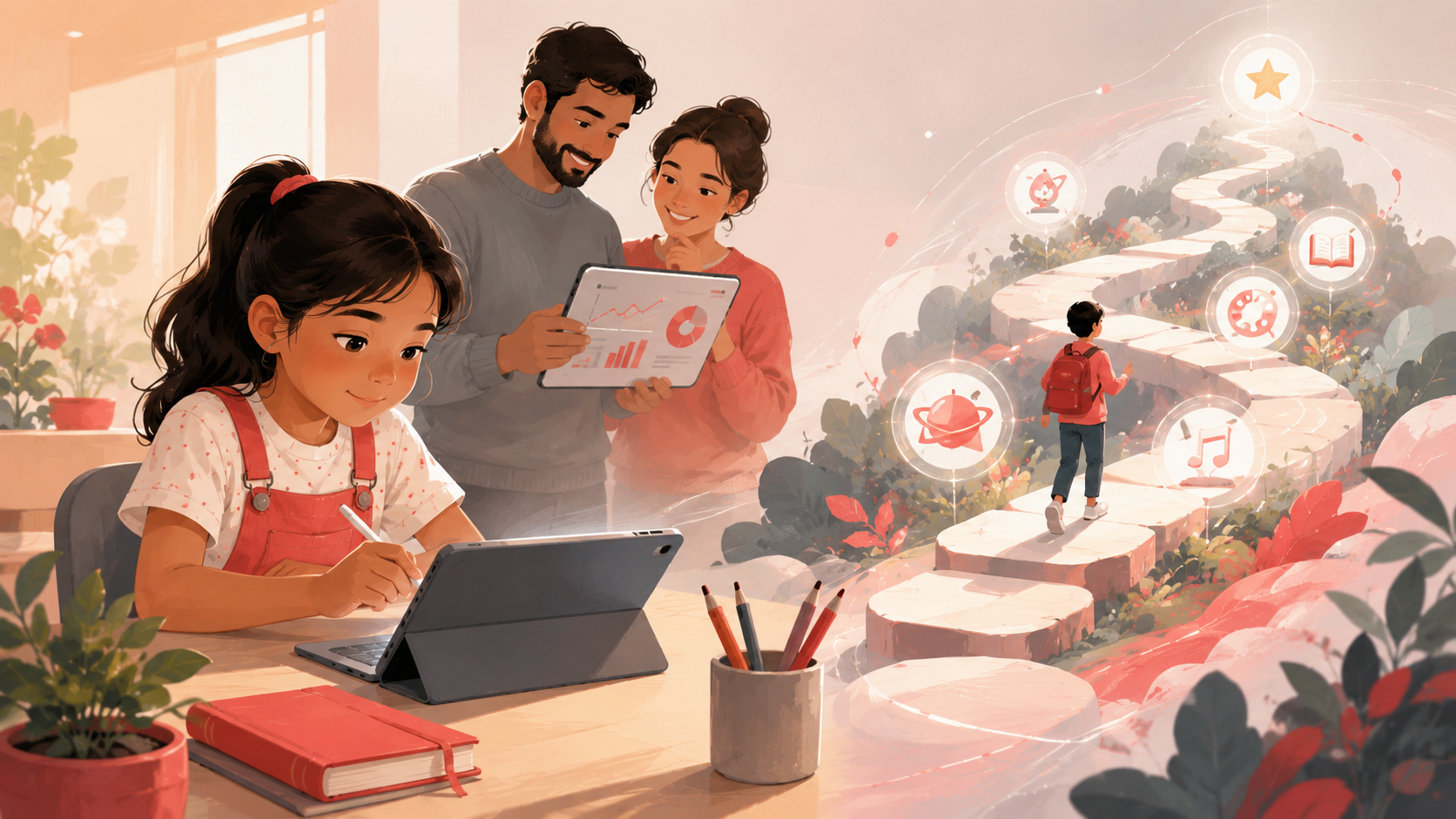
One of the biggest advantages of personalised learning technology is the clarity it gives you as a parent. Instead of vague feedback or occasional updates, you get a clear view of your child’s strengths and areas that need gentle reinforcement.
You’re able to see:
- Which topics your child has mastered?
- How long do they take to learn new concepts?
- What patterns show up in their progress?
- Where do they need more encouragement or practice?
Take the example of Meera, a mother of a 7th grader named Rishaan. She always felt unsure whether her son truly understood his lessons because he rarely spoke about school. After shifting to personalised learning tools, Meera began receiving weekly insights that showed Rishaan excelled in Math problem-solving but took extra time to grasp grammar concepts. She could also see that he learned new lessons faster in the mornings than late evenings.
For the first time, Meera felt she genuinely understood how her child learns. Instead of guessing or worrying, she began guiding him more confidently. She helped him revise grammar through small daily activities and scheduled more challenging subjects during his “high-focus” hours. Within a month, Rishaan not only improved but also felt more supported and less stressed. Meera often says, “These insights didn’t just teach me about his academics; they helped me understand my child better as a person.”
Gamification: Making Learning Feel Natural and Fun
Children naturally learn faster when they’re engaged, curious, and excited. That’s why many learning platforms today include playful elements like badges, levels, characters, and rewards, all thoughtfully integrated to support personalised learning paths.
These elements do more than just entertain. They:
- Encourage consistent engagement
- Reduce pressure associated with academics
- Help children celebrate small wins
- Keep learning aligned with each child’s pace
For children who find traditional classroom work stressful or repetitive, gamified, personalised learning often becomes a refreshing and enjoyable way to build confidence.
Consider Ananya, a mother of an 8-year-old named Vihaan. Vihaan often felt overwhelmed in traditional classroom settings. Whenever he struggled with a concept, he would quietly give up, thinking he just “wasn’t good at it.” But once he started using a gamified learning platform, everything changed.
Instead of feeling pressured, he became excited to earn badges, unlock levels, and complete challenges designed just for his learning pace. One day, Ananya noticed Vihaan eagerly practicing multiplication-not because he was asked to, but because he wanted to earn the “Math Master” badge. Over time, she saw his confidence grow. He stopped hesitating, started asking more questions, and even began teaching concepts to his younger cousin.
Ananya says the biggest change wasn’t just academic improvement. It was seeing her child smile while learning and finally believing in his own abilities.
Al Tutors and Virtual Assistants: Support Beyond the Classroom
Imagine your child needing help with fractions at 7 PM, long after school ends and you’re tied up with dinner or work. Al tutors step in exactly at moments like these.
They are designed to:
- Offer explanations in child-friendly language
- Provide step-by-step guidance
- Answer questions instantly
- Adjust explanations if your child needs a simpler or different approach
This ensures learning never hits a dead end. With always-available support, your child can move through lessons on their own timeline, whether they’re quick learners, careful thinkers, or somewhere in between.
Think of Rahul, a father of a 6th grader named Ishita. She often struggled with fractions and word problems, but by the time she sat down to study in the evening, Rahul was usually busy wrapping up work calls. One night, Ishita felt stuck again and almost gave up. Instead of waiting for the next day or getting frustrated, she opened her Al tutor.
The tutor explained the problem step by step, using simple visuals and comparisons that made sense to her. When Ishita still looked unsure, the Al adjusted the explanation and offered an easier example. Within minutes, she understood the concept and proudly solved the rest on her own.
Rahul later said, “I didn’t just see her scores improve. I saw her confidence grow because she no longer had to wait for help. She felt capable.”
Customized Lesson Plans: Matching Your Child’s Goals and Interests
Another powerful advantage of personalised learning paths is how flexible and child-centered they are. The system doesn’t just adapt to their pace, it adapts to their personality.
If your child loves stories, the platform can use narrative-based examples. If they’re fond of animals, numbers or letters might be tied to animal themes. If they’re focusing on improving specific skills, the platform reshapes the plan to meet those needs.
This keeps learning relatable, enjoyable, and consistent with your child’s interests and goals, helping them retain knowledge more effectively.
For instance, one virtual school – The World Ecademy emphasises “live, engaging and fully interactive lessons” in small class sizes specifically so teachers can focus on each student’s unique needs, enabling exactly this kind of child-centred, flexible learning environment.
Take the example of Kavya, mother of a 5th grader named Aarush. Aarush is a deeply imaginative child who understands almost everything better through stories. Traditional textbooks often left him confused, but the moment his personalised learning platform began turning math problems into small adventures, everything changed.
Instead of simply “solving fractions,” Aarush was suddenly helping a fictional explorer divide treasure on an island. When he learned grammar, characters from his favorite books guided him through the rules. The platform even adapted when Aarush showed a growing interest in
space, turning word problems into rocket missions and math steps into countdown
sequences.
Kavya noticed that learning no longer felt like a task for him. He concentrated longer, remembered concepts faster, and most importantly, looked forward to studying time each day. She often says, “When lessons started speaking his language, everything finally made sense to him.”
This is exactly the kind of child-centered approach The World Ecademy nurtures through its live, interactive classes. Small groups allow teachers to understand each child’s interests and weave those elements into the lessons, so students learn in ways that feel natural, engaging, and personal.
The Parent’s Role in the Personalised Learning Journey
Technology may be powerful, but your involvement still matters. You don’t have to be hands-on all the time; even small actions can make a big difference.
Supporting your child becomes easier when you:
- Celebrate the progress the platform highlights
- Ask what they enjoyed learning today
- Use insights to gently guide their practice
- Show interest in their unique learning style
When you and smart technology work together, your child gets a learning environment that is both structured and supportive, perfectly suited to their natural pace.
Final Thoughts
Personalised learning paths are not just another education trend, they represent a shift toward respecting each child’s individuality. Thanks to technology that adapts to your child’s pace, learning finally becomes something personal, meaningful, and empowering.
Instead of your child trying to fit into a rigid system, the system now flexes for them, giving them space to grow, learn, and thrive exactly the way they’re meant to.